Bainbili
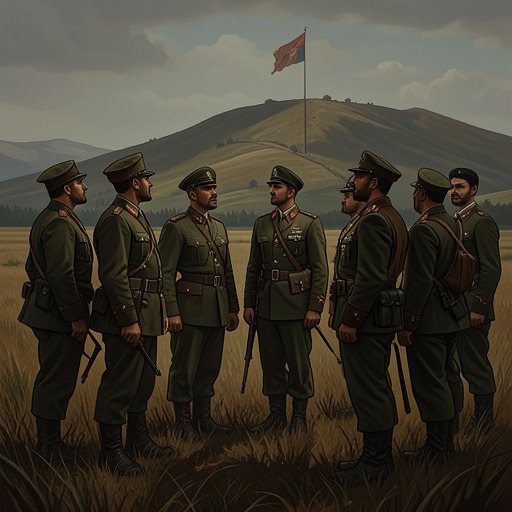
The DispossessedBenbili is a large, poor, underpopulated country in the western hemisphere, described as a landscape of mountains and arid savannahs. Though formally a parliamentary democracy, it is actually ruled by military generals. Its revolution, reported from afar during Shevek’s stay on Urras, makes the country a focal point for his hopes of freedom and his growing recognition that powerful states can turn political ideals into instruments of intervention.
Country and Political Setting
Benbili’s formal democracy masks a military dictatorship. The country’s poverty and sparse population distinguish it from the affluent centers of Urras, while its mountains and dry grasslands give Shevek an imagined landscape that draws him toward it. Reading about the country, he thinks he should have gone there; the place is at first a possibility glimpsed through news and geography rather than a destination he reaches.
Revolution and Intervention
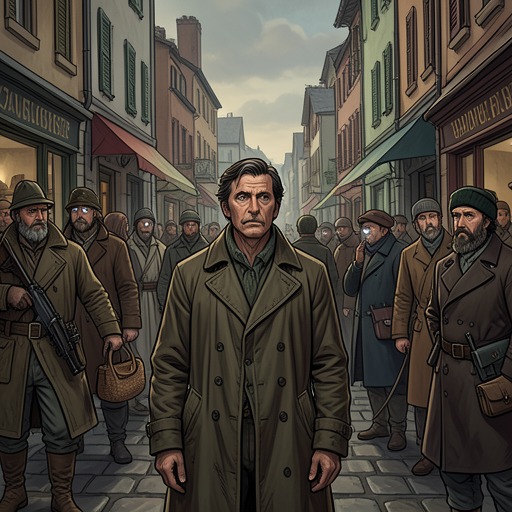
News announces that the revolutionaries have taken the capital, Meskti, and that the dictator has fled. President-General Havevert escapes in his armored airplane, while retreating government forces burn fields and towns. Guerrilla partisans harry the army, and the revolutionaries open the jails and grant amnesty to prisoners. That act lifts Shevek’s heart: the reports make the uprising seem to offer a real opening for freedom.
The promise is quickly shadowed by foreign power. On the fourth day, Shevek hears the Ioti ambassador announce that A-Io will send armed reinforcements, supposedly in support of Benbili’s democratic government and Havevert. The revolutionaries are mostly unarmed; the intervention force has guns, armored cars, airplanes, and bombs. Faced with this imbalance, Shevek feels sick and enraged. The country’s struggle is thus made vulnerable not only to its own retreating army but to the military resources of a stronger state.
Benbili in Urras’s Power Politics
The intervention is presented by Oiie as a police action that maintains a balance between A-Io and Thu: although the states are officially at war, he claims they have outgrown the barbarism of fighting one another directly. Their armies will instead fight in Benbili, where Thu still holds two eastern provinces. Oiie’s account treats the country as the arena in which rival powers manage their competition, rather than as a people whose political future is at stake.
Shevek rejects the ease of that abstraction. Oiie argues that the rebels are discovering that freedom cannot endure without guns, and that the larger reality is the power struggle between A-Io and Thu. The news has already shown Shevek what such reasoning means in practice: a largely unarmed revolution faces a modern army sent by a foreign power. Benbili’s revolution therefore reveals the coercive underside of Urras’s declared restraint, while intensifying Shevek’s isolation among those around him who either support militarism or explain intervention as political necessity.